The UK government are introducing calories to menus to lower obesity statistics

In an attempt to tackle the UK’s obesity rates, The Government have announced through the Department of Health and Social Care, that starting from April of 2022 Cafes and restaurants will be required to add the number of calories of the products they serve onto their menus. The government believe this will assist the public to evaluate their meal choices and aid them to making healthier decisions.

According to UK Parliament obesity statistics from 11th January 2021, ‘28% of adults in England are obese and a further 36% are overweight’.

@beatED, the UK’S online eating disorder charity has spoken out about the concerns they have about this having the opposite impact on those who struggle with eating disorders. In a tweet responding to @HuffPostUK announcing the news of the new Government plans, “We are extremely disappointed with these plans, despite clear evidence it is ineffective and dangerous to people affected by eating disorders. We urge parliamentarians to protect people with Eds and oppose this legislation. #QueensSpeech #MHAW”

According to prioritygroup.com, ‘Between 1.25 and 3.4 million people in the UK are affected by an eating disorder

 The charity has drafted a letter available for anyone to send to their local MP. The letter expresses how and asks to reconsider putting these measures into place, it is captioned ‘Public Health Not Public Shaming’. They announced on Twitter that “4,267 people have written to their local MP’s” and added that the “letters have gone to 625 out of 650 MP’s”.  You can find the letter here: https://t.co/PY7VRg9ffk?amp=1

Registered Dietitian MSc, Joana Jardim says “Checking the nutrition label is a good way of comparing products and making informed decisions, in the context of choosing products in the supermarket but in the context of a restaurant, where the nutrition information will be just provided as a number of calories, it wouldn’t be informative enough to make healthier choices”

“We need to educate consumers to look at the whole composition of the dish, checking if it contains vegetables, low saturated fat protein sources, whole grains, etc. We also should be educating the consumer to avoid fried foods and avoid high sugary desserts”.

Her opinion is that “it would be a lot more beneficial in terms of overall health and tackling obesity, to provide healthier alternatives on the restaurant menu than just providing the number of calories of the dishes.”

You can visit Joana’s website for specialist advise here

If you are affected by any of the issues raised, you can call:

BeatED Helpline: 0808 801 0677

Samaritans: 116 123
Restriction-free events return for the music lovers of Liverpool

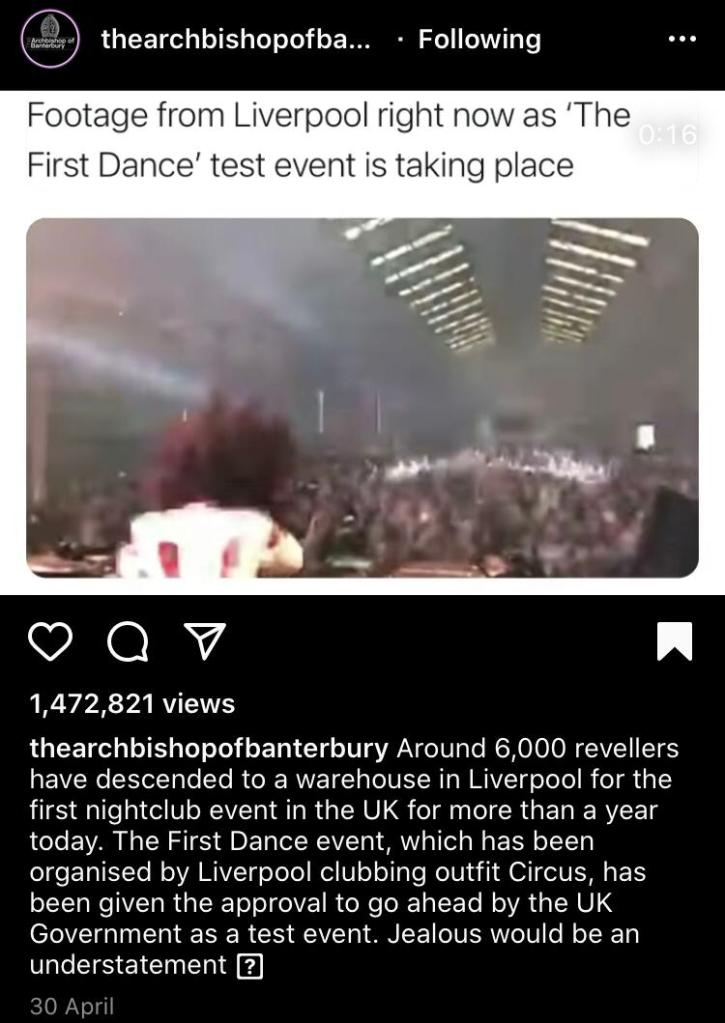
The 30th of April goes down in the history books for being the first event with zero restrictions since Covid-19 sent the UK into lockdown back in March of 2020. Six thousand Liverpool residents gathered at Bramley-Moore Dock to attend the first of a sold-out, two-day event called ‘The First Dance’, hosted by ‘CIRCUS music (@circusmusic on Instagram).

Videos of the night were shared over social media by teenagers and  young adults admitting their jealousy of the ravers from Liverpool.

Just two days after The First Dance event, 5000 more music lovers gathered at Liverpool’s Sefton Park to attend the popular indie-band ‘Blossoms’ Pilot show.

Lucia Manfredi, 18, from Liverpool attended Blossoms’ returning gig. “For our tickets to be activated, we had to go to a test centre the day before and test negative”, she explained that to qualify for tickets you had to be from the Liverpool City Region.

There was no sense of worry for Lucia wasn’t about catching the virus as “it was the safest place to be if everyone had to test negative”. Safety precautions were still in place as they were given two extra tests for at home, one for on the day and one to take 5 days after.

“The atmosphere was electric… people were just so happy…everyone was hugging and laughing and it just felt so normal like the past year had never happened”

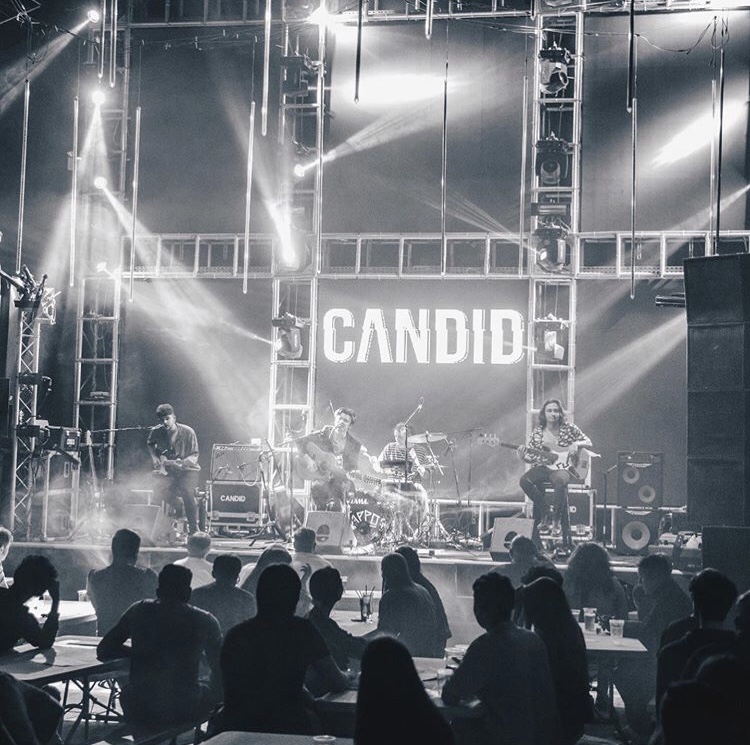
Dan Latimer, lead guitarist of indie rock band, ‘Candid’ from Coventry expressed his gratitude for seeing these events take place. “Seeing these gigs with huge audiences taking place again really gives me hope for the upcoming months”. Dan’s band were scheduled to play a sold-out concert which they were headlining, back in March of 2020, just a week after the UK went into lockdown. “The pandemic has been gutting for everyone, and musicians and music lovers were really feeling the blow. Not being able to play our biggest show to date was a real shame but having a rescheduled date over a year later and seeing Blossoms successfully perform a gig with no restrictions would put a smile on any musicians face”.

Knife crime in the UK remains a contemporary issue as another young life is lost.

On the 31st of May, bank holiday Monday, 14 year old Dae-John Reid lost his life at the hands of a knife. The young teenager was said to be Kingstanding area of Birmingham. He was stabbed around 7.30pm, leaving him with a fatal chest injury before passing away at the scene. There are reporting’s of the crime being racially driven, but this is yet to be confirmed.

Six people were arrested following the crime, with ages ranging from as little as 13 to 38. Two of the teenagers have been charged with the murder of Dae-John, one of them facing charges against him for possession of an offensive weapon. The others remain in police custody.

According to The Ben Kinsella Trust Knife Crime Statistics , there were 46015 cases of knife related offences recorded by the police in the year of 2020. There has also been a 71% Increase in knife crime in England and Wales since 2014.

Back in 1993 on the 22nd of April, an eighteen-year-old boy called Stephen Lawrence also lost his life after being stabbed to death in a racially motivated attack by a gang of white men. A charity was set up in his memory originally called the ‘Stephen Lawrence Charitable Trust’ which now goes by ‘Blueprint for all’. The organisation works with young, disadvantaged people to provide them with opportunities to thrive in their talents and work towards systemic change. You can learn more and support their work at BluePrint For All.  Since the loss of his life, we have recently celebrated the third annual ‘Stephen Lawrence day’- find out more at https://stephenlawrenceday.org/

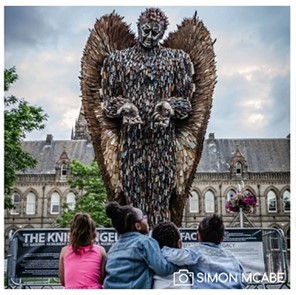
Over time there have been numerous attempts to spread awareness of the knife crime issue in the country. In 2018, A statue of an angel made entirely from 100,000 confiscated knives travelled around the UK on an ‘Anti-violence’ as a preach for social change. The statue was labelled a ‘national monument against violence and aggression’. For more information about the Knife angel and the ‘Anti violence tour’ visit: https://www.britishironworkcentre.co.uk/show-areas/the-knife-angel-official

Music venues across the UK are making necessary changes in a struggle to stay open

Mandatory mask wearing, capping admission numbers and strict seating plans are some of the vital new measures being enforced in order to keep the music industry alive. Venues across the country are finding ways to combat the spread of Covid-19 in an attempt to stay open and support a struggling live music scene. With over 400 grassroots venues in crisis, Coventry’s Kasbah and The Dark Horse in Birmingham are two amongst many venues that are working through this pandemic and introducing these new measures.

In 2018, £1.1bn was made by the live music sector alone, not forgetting the £5.2bn the music industry adds to the economy as a whole. Live performances play huge part in not only revenue, but the lives of artists and consumers. This years change in normality has left companies out of pocket and people itching for a good show – venues have stepped up their safety game to ensure peoples prayers are answered.

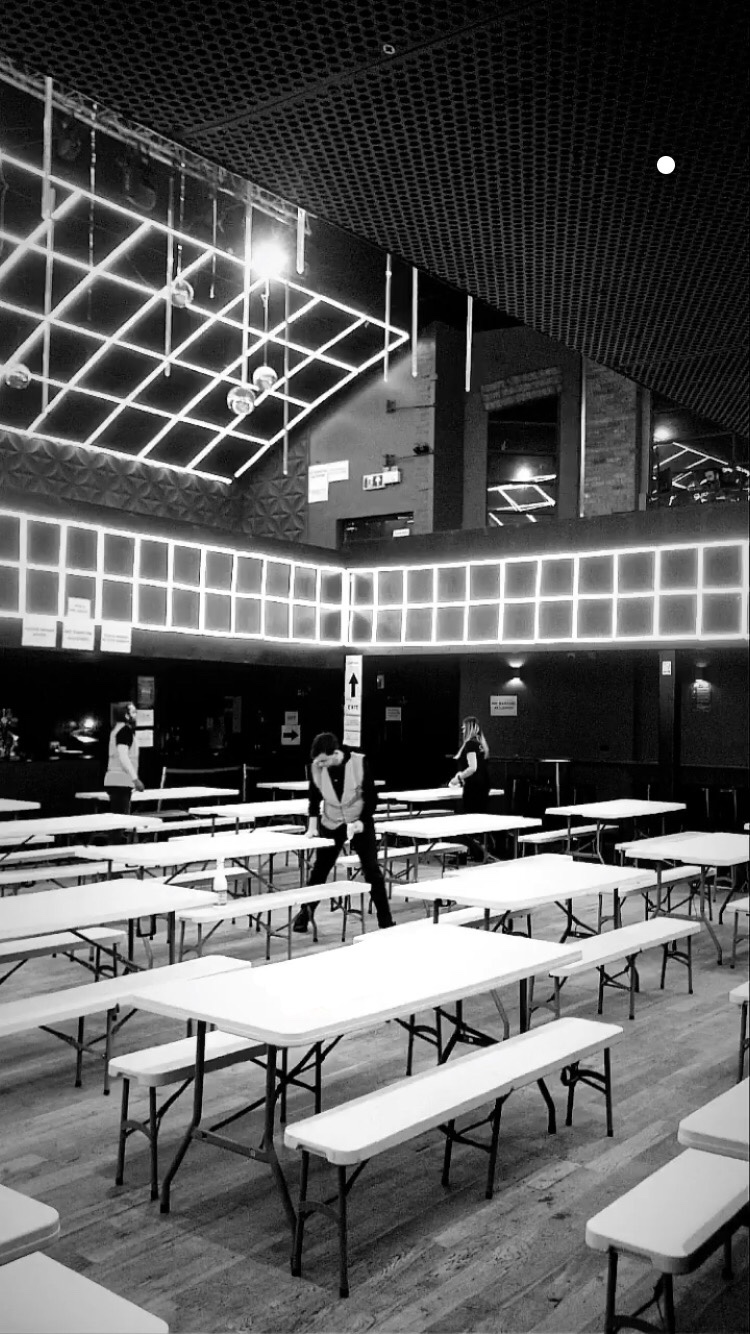
The Dark Horse in Moseley, Birmingham, has a usual capacity of 200 people; however, the venue has capped events at 45 tickets to ensure social distancing measures can enforced. The Kasbah in Coventry has also had to cap their shows from 1000 to 180 for the same reasons and to allow space for tables since standing gigs are no longer permitted. From now on you can only purchase tickets in tables to avoid mixing households and bubbles as much as possible, when you arrive you are to shown to your set table and are to wear a mask everywhere in the building unless you are seated at your designated table.

Myles Cheshire, a solo artist who has recently performed at both venues believes that “These measures are necessary at the moment to keep everyone as together and as happy as possible” and that “Creating a safe environment for live shows is a must to keep venues open and supported in these times”.

Artists and musicians to “reskill” statement causes upset and anger amongst young workers.

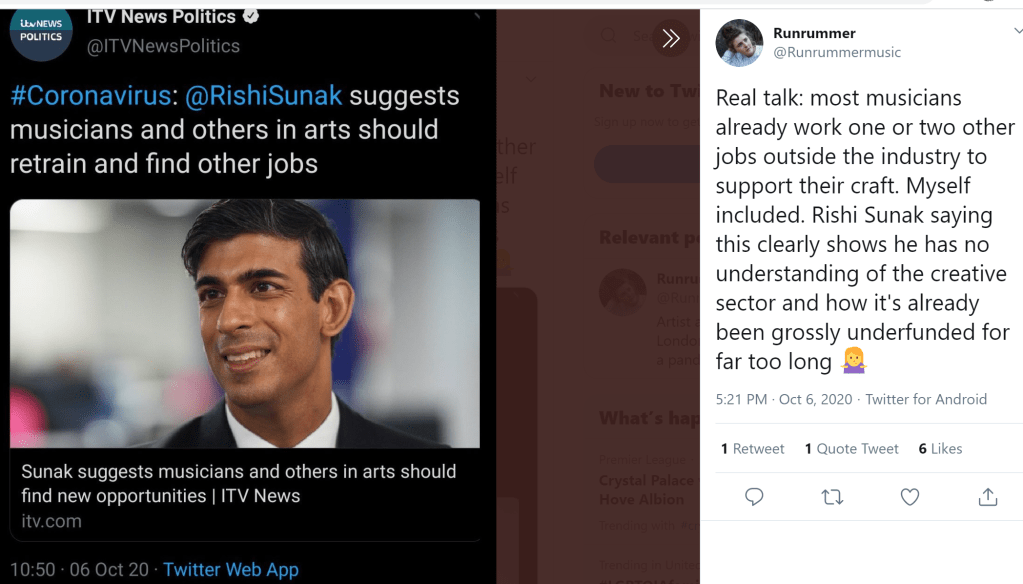
Musicians and artists across the UK were left angry and upset following a tweet from ITV news suggesting Rishi Sunak had told them that “musicians and others in the arts should retrain and find other jobs”. Although ITV have since deleted the tweet and Rishi has denied saying this, other statements from Sunak still point towards the same outcome.

The combination of Rishi saying he “can’t save every job” and repeating that they are “trying to create fresh and new opportunit[ies] for people” after being asked about the arts and music industry doesn’t look positive for the artistic sectors.

Musicians and artists took to twitter in dismay to express their feelings following these statements. Discussing how they have always had two work two jobs and agree that the music industry is “underfunded”. East London based musician @runrummermusic tweeted “Real talk: most musicians already work one or two jobs outside the industry to support their craft…Rishi Sunak saying this clearly shows that he has no understanding of the creative sector and how it’s already been grossly unfunded for far too long”

I asked Georgia Blackman of Happy People Music (@happypplmusic) blog some questions as someone who has recently completed a degree in Music Journalism and her thoughts on the situation.

How do you feel as someone who’s just spent three years getting a degree in music journalism to now be told that people in your area of expertise should look for ‘new and better jobs’?

It makes me feel rather angry and I feel like I’ve wasted my time doing what I love. It’s degrading to tell a whole sector that they need to find other jobs and reskill – the industry is full of hard workers and passionate people like myself and I don’t think the government fully recognise the potential that they’re throwing away.

You are the founder of Happy People Music blog, which has been growing rapidly recently, are you worried about how the lack of support for the music and arts industry may impact the future of your work?

“I don’t think it will impact my website in particular because online work will continue to thrive… I do however worry about my future plans in terms of other career paths that I was looking forward to try and explore. It’s a tough time for the industry but I know it will bounce back to the amazing energy we all seem to carry and what the government are throwing at us at the moment!”

Will social media filters have an impact on your child’s health?

The filter feature on photos of yourself and others can be fun, from making your friends look silly to creating aesthetically pleasing images to post on your feed. But if you really pay attention to what these filters do, you may start to see where the the problems may lie.

With the youth of today growing up in a world that revolves around the internet and seeing what their favourite influencers are doing, false expectations of life and self image starts to become the norm. The new beauty standards for every gender are unrealistic and hard to reach. From tiny noses to tiny waists, its hard for anyone to become completely satisfied with their appearance.

Snapchat and Instagram filters are widely popular and are used to enhance images to make people feel more confident in their selfies, but the issue behind this is what the filters do. A lot of the enhancements when using these tools tend to slightly slim your face while making your eyes appear bigger and your nose smaller. Although these are just tiny differences, when young people use these tools as a way to feel pretty, it could start to create a false reality of how they should appear, which could cause self confidence issues and dysmorphia.

Make-up student, Grace Elliott (age 18) told us that “It makes you feel like your face isn’t good enough, and that they think so to because they’re completely changing it.”

The internet can be a very useful tool, but it’s important not to lose your sense of reality.

Student life in 2020- My first week of university during a worldwide pandemic.

You never fully know what to expect when moving to university for the first time, but usually you hear stories that make it easier to piece together an idea of what’s coming your way. Due to the current climate with the recent outbreak of Covid-19, students are entering a new chapter of their lives pretty much blind.

Meeting people is hard. Unless they’re on your course or living with you, its hard to form new relationships with people. Since freshers is pretty much non existent this year, to actually run into new people and get talking isn’t very likely, especially when all groups are capped at six people maximum. Even if you do go to a freshers event, you will be seated at a table and asked to remain seated, therefore there isn’t actually a way of speaking to anyone else who’s gone to the same event. Although these measures are being enforced for our own safety, its hard not to think students aren’t missing out on a vital part of the university experience.

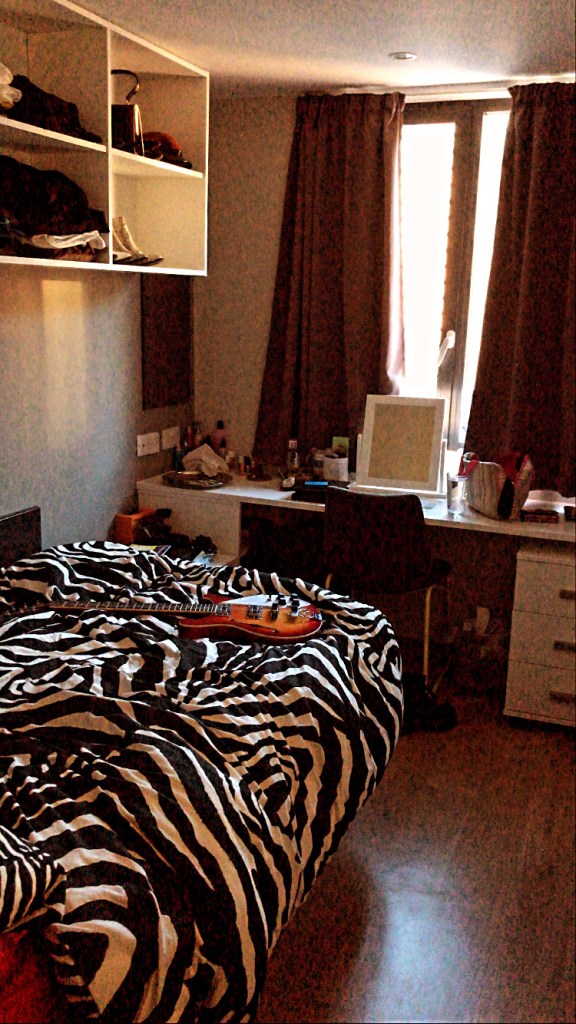
One thing that hasn’t changed is that we still get to make our new rooms our own, and since we’re going to be spending more time than originally anticipated in them, its nice to decorate them the way we like.

Hundreds of Coventry University students put their health and morals on the line in a huge halls party.

This week, residents of Coventry were shocked to find videos surfacing on the internet of a huge illegal gathering which took place in a student accommodation. The videos were uploaded to social media around 3am on the 29th of September. The current social distancing guidelines state that you must not gather in groups larger than six and people who breach this rule could face a ten grand fine.

Students are receiving the majority of their education virtually this year, with drastically less face to face learning in an attempt to lessen the spread of Covid-19. Any on-campus learning has to be done whilst wearing a face masks to ensure the university stays at clean as possible. These measure are put in place to help ensure the safety of students on campus, but off campus the health of students cannot be monitored when groups of this size are congregating with no signs of PPE being worn.

I reached out to Coventry University third year student Rob Latimer to ask for his feelings towards students meeting in the masses to party, whilst he is having to work from home. This was his response- “I believe it’s a total lack of empathy and respect for fellow students. The limited contact hours we get at the moment shouldn’t be jeopardised by the selfish acts of those wanting to party. More than likely, this is merely one of many and really makes you wonder whether the University is in fact sterile and safe to use, when students show a total disregard for the safety of their peers.”

There is currently an investigation into whether the gathering had been pre-planned.